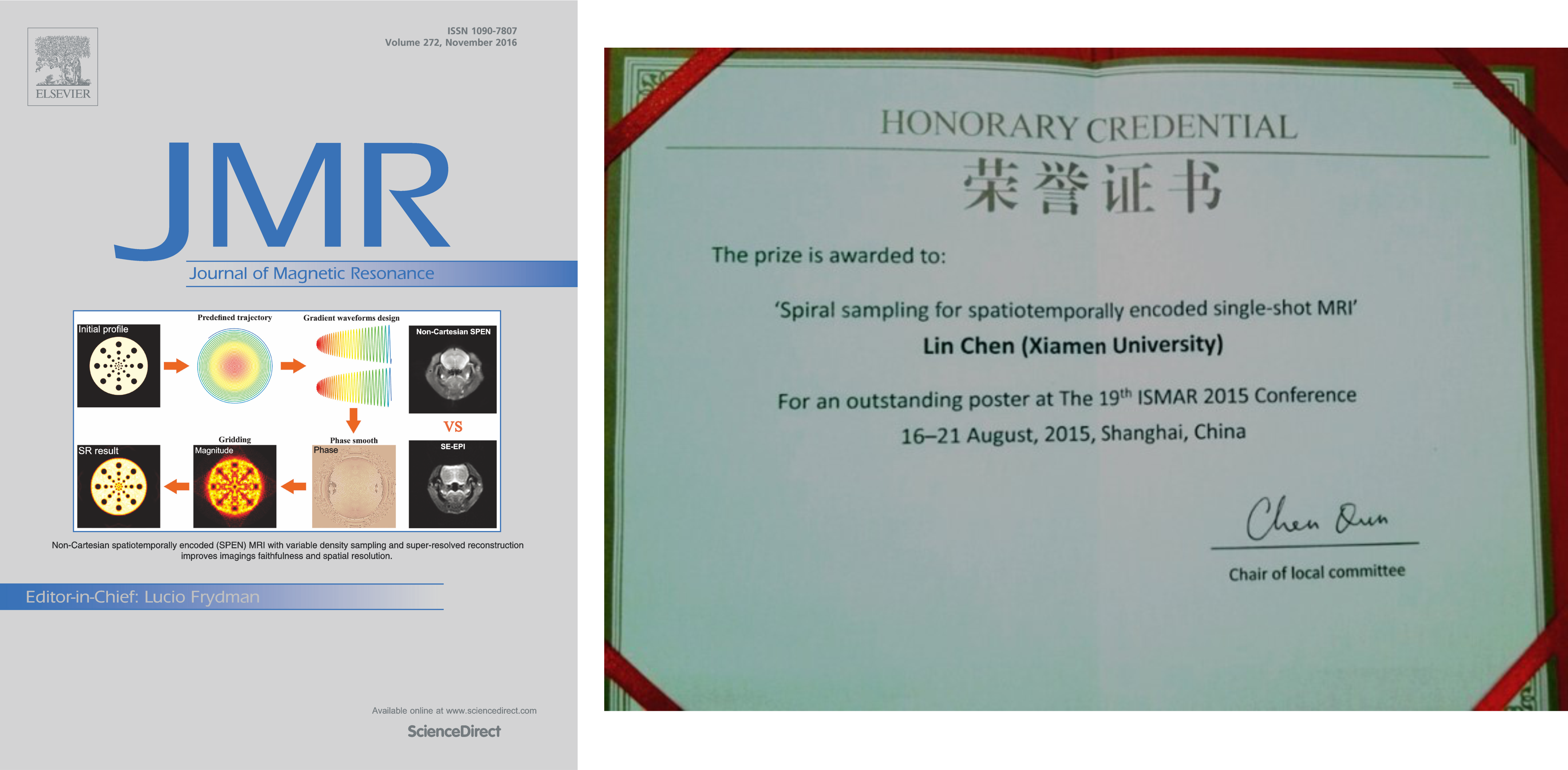
Non-Cartesian SPEN MRI was featured as outstanding poster at the 19th ISMAR conference and cover of Journal of Magnetic Resonance
Published:
Our paper Chen L, Huang J, Zhang T, Li J, Cai C, Cai S. Variable density sampling and non-Cartesian super-resolved reconstruction for spatiotemporally encoded single-shot MRI. J Magn Reson 2016;272:1-9. was selected as outstanding poster at the 19th ISMAR conference and cover of Journal Magnetic Resonance.
Introduction of this work
Spatiotemporally encoded (SPEN) single-shot MRI is an emerging ultrafast technique, which is capable of spatially selective acquisition and reduced field-of-view imaging. Compared to uniform sampling, variable density sampling has great potential in reducing aliasing artifacts and improving sampling efficiency. In this study, variable density spiral trajectory and non-Cartesian super-resolved (SR) reconstruction method are developed for SPEN MRI. The gradient waveforms design of spiral trajectory is mathematically described as an optimization problem subjected to the limitations of hardware. Non-Cartesian SR reconstruction with specific gridding method is developed to retrieve a resolution enhanced image from raw SPEN data. The robustness and efficiency of the proposed methods are demonstrated by numerical simulation and various experiments. The results indicate that variable density SPEN MRI can provide better spatial resolution and fewer aliasing artifacts compared to Cartesian counterpart. The proposed methods will facilitate the development of variable density SPEN MRI.